A fixed-capacity ring buffer (circular buffer). More...
#include <ring_buffer.hpp>
Public Member Functions | |
| RingBuffer (size_t capacity=0) | |
| Constructs a RingBuffer with a given capacity. More... | |
| void | set_capacity (size_t capacity) |
| Resizes and resets the buffer. More... | |
| void | push_back (const T &val) |
| Pushes a new element into the buffer. More... | |
| T & | operator[] (size_t i) |
| Access element by logical index (0 is oldest). More... | |
| const T & | operator[] (size_t i) const |
| Construct element by logical index (0 is oldest). More... | |
| T & | back () |
| Access the newest element. More... | |
| const T & | back () const |
| Access the newest element (const). More... | |
| size_t | size () const |
| Returns the number of elements currently stored. More... | |
| bool | empty () const |
| Checks if the buffer is empty. More... | |
| bool | full () const |
| Checks if the buffer is full. More... | |
| void | clear () |
| Clears the buffer content. More... | |
| void | reserve (size_t n) |
| Reserve capacity (resets buffer if new capacity > old capacity). More... | |
Detailed Description
template<typename T>
class cpu_mlp::RingBuffer< T >
A fixed-capacity ring buffer (circular buffer).
Efficiently stores a sliding window of elements. Pushing back when full overwrites the oldest element (logical index 0). Accessing index i corresponds to the (i)-th oldest element.
Constructor & Destructor Documentation
◆ RingBuffer()
|
inlineexplicit |
Constructs a RingBuffer with a given capacity.
- Parameters
-
capacity Maximum number of elements to store.
Member Function Documentation
◆ back() [1/2]
|
inline |
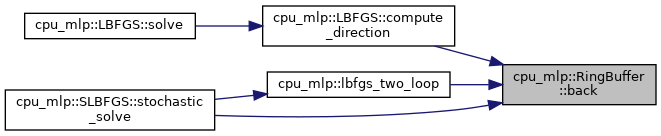
Access the newest element.
- Returns
- Reference to the newest element.
◆ back() [2/2]
|
inline |
Access the newest element (const).
- Returns
- Const reference to the newest element.
◆ clear()
|
inline |
Clears the buffer content.

◆ empty()
|
inline |
Checks if the buffer is empty.

◆ full()
|
inline |
Checks if the buffer is full.
◆ operator[]() [1/2]
|
inline |
Access element by logical index (0 is oldest).
- Parameters
-
i Index.
- Returns
- Reference to the element.
◆ operator[]() [2/2]
|
inline |
Construct element by logical index (0 is oldest).
- Parameters
-
i Index.
- Returns
- Const reference to the element.
◆ push_back()
|
inline |
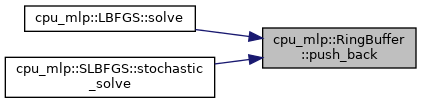
Pushes a new element into the buffer.
If the buffer is full, the oldest element is overwritten.
- Parameters
-
val The value to push.
◆ reserve()
|
inline |
Reserve capacity (resets buffer if new capacity > old capacity).
- Parameters
-
n New capacity.

◆ set_capacity()
|
inline |
Resizes and resets the buffer.
- Parameters
-
capacity New capacity.

◆ size()
|
inline |
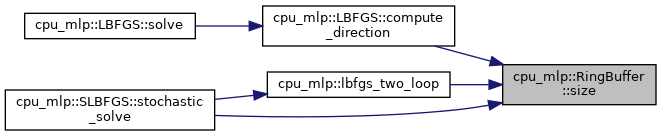
Returns the number of elements currently stored.
The documentation for this class was generated from the following file:
- src/minimizer/ring_buffer.hpp